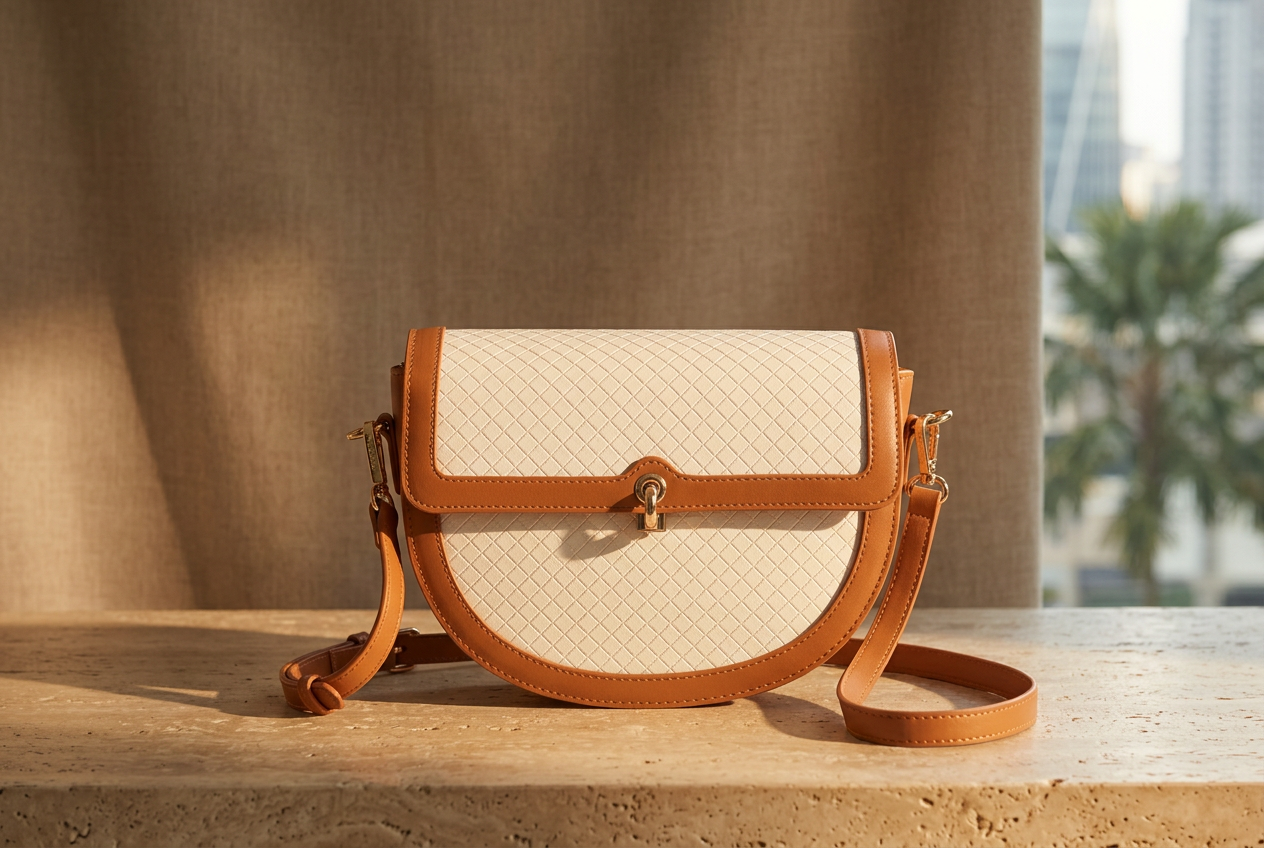
Four checks, thirty seconds
You do not need a lab. You need your hands, your eyes and about half a minute at the counter.
- Grain. Genuine hide has irregular pores — no two square centimetres match. A repeating pattern every few centimetres is an embossed synthetic.
- Edge. Look at a cut edge or the underside of a strap. Leather shows fibrous, slightly fuzzy layers; coated fabric shows a clean line where finish meets backing cloth.
- Press. Press a thumb into a flat panel. Leather wrinkles outward in fine irregular lines and settles back slowly. Synthetic dents and springs straight back.
- Warmth. Rest your palm flat for ten seconds. Leather warms to your skin. Most coated finishes stay cool a beat longer.
What the labels actually mean
The wording on a swing tag is regulated loosely and reads more optimistically than it should. A short translation:
- Full-grain — the top layer of the hide with the grain intact. The most durable, and it develops a patina.
- Top-grain — the same layer lightly sanded and finished. Slightly more uniform, still genuine and hard-wearing.
- Genuine leather — a lower split of the hide. Real, but the weakest of the three despite the reassuring name.
- Bonded leather — scraps ground and glued to a backing. It behaves like a synthetic and should be priced like one.
- Vegan or PU leather — a coated fabric. Says nothing about quality on its own; the coating and backing decide that.
The honest answer is that a well-made coated bag will outlast a poorly made genuine-leather one, especially in this climate.
Why this matters more in Malaysia and Singapore
Humidity is the deciding factor. Untreated hide absorbs moisture and, in a still cupboard at eighty per cent relative humidity, will bloom with mould long before a coated finish does. A quality synthetic is genuinely the lower maintenance choice here — that is not a compromise, it is a climate-appropriate decision.
What we would not compromise on: stitching density, hardware quality, and how the lining is attached. Those decide whether a bag lasts five years or one, far more than the material label does.
The one check most people skip
Open the bag and look at the seam where the lining meets the body. If the stitches are even, close together, and the seam allowance is finished rather than raw, the rest of the bag was almost certainly made to the same standard. If that seam is sloppy, put it down — whatever the exterior is made of.